About
I started playing tennis when I was five, and by my teens it was my whole life. I was home schooled through Years 11 and 12 so I could travel, and in 2008 I played the Australian Open juniors, ranked just outside the world's top 100.
At 17 I lost the feeling in my left leg. Nobody could tell me why, so I did what athletes do and adapted, training and playing around it for four years. At 21 I was on a tennis scholarship at Texas A&M, playing Division 1, when a flare-up brought an indescribable burning pain to that same leg. With my family on the other side of the world, I sat by myself in a sterile white clinical office and was diagnosed with multiple sclerosis. After four years I finally had an answer, but all I could hear was no cure and rapid decline. With a year left on my scholarship, I decided to give up the sport I'd spent my life playing, finish my degree, focus on my health and move home to Perth. My left leg is still numb today.
Without tennis, I didn't know who I was, so I threw myself into work. Over the next decade I worked in sport development, as Club Development Officer at the City of Armadale, Sport Development Manager at Netball WA and Female Engagement Specialist at the WACA, building opportunities for women and girls rather than competing myself.
In April 2019, bored and missing the adrenaline of competing, I decided to try Australian rules football, a sport I had never played and whose rules I didn't really know. Six months and four games later, I was drafted by the Fremantle Football Club. In only my second AFLW season, in 2021, I was named All-Australian, playing elite football on a leg I can't feel. My neurologists' reaction was mostly disbelief.
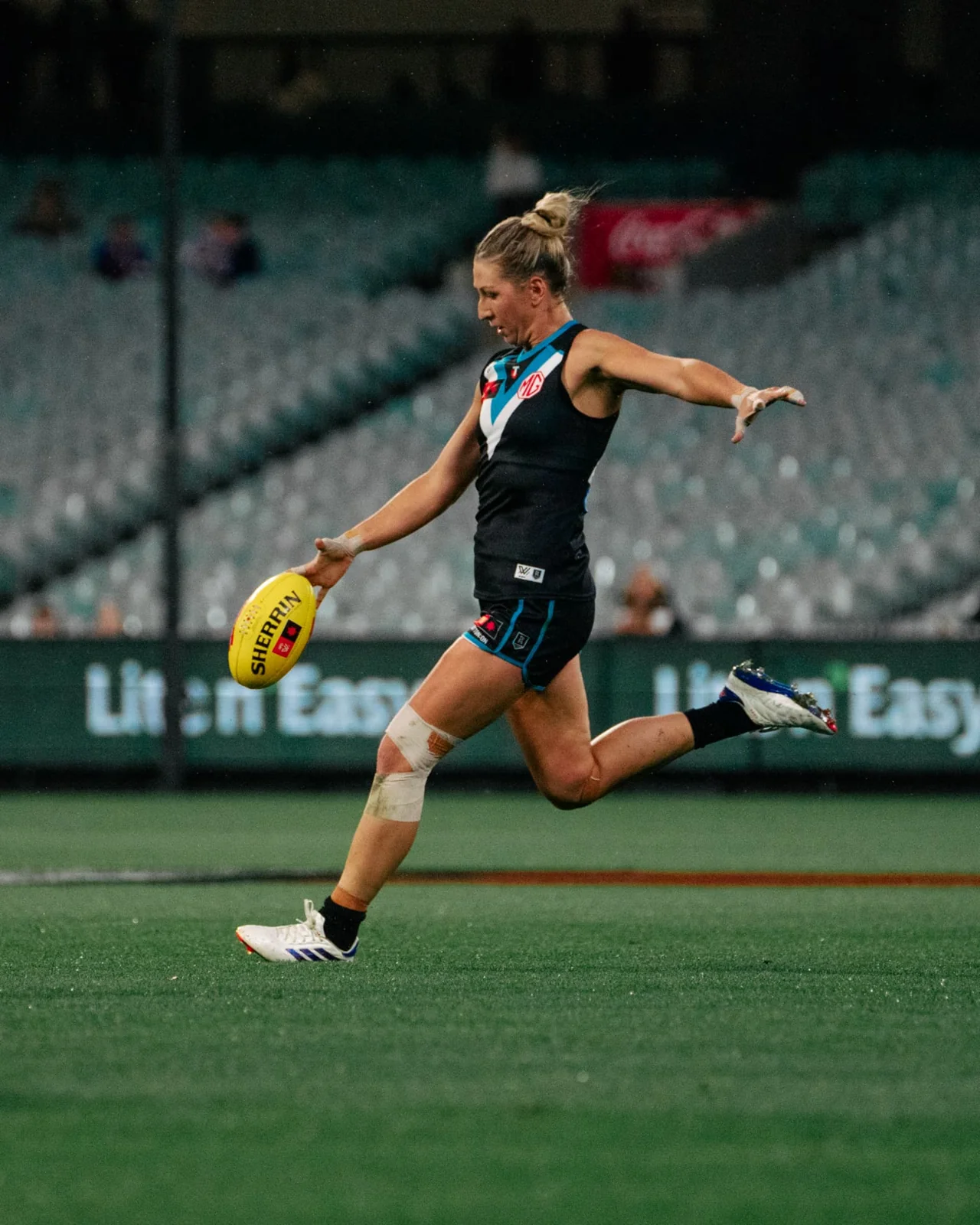
Then came 2022, with two AFLW seasons squeezed into one calendar year, played through COVID while I was working full time, and a run of injuries that ended my season. I came close to retiring, but instead I gambled on a new environment. In 2023 I packed up my life for a second time and moved from Perth to Adelaide as a priority signing for Port Adelaide, where I was voted in by my peers as vice captain under Erin Phillips.
In 2024 I was named captain. Round 1 was at Alberton against the Crows, the first time our AFLW side wore the prison bar guernsey, and Round 2 was the first AFLW game ever played at the MCG, where I ruptured my ACL. Two days after surgery I was back at the club leading from the sidelines, because that was what I knew how to do.
"Hearing Janelle share her journey as a professional AFLW player was deeply moving. Her story was one of extraordinary determination, resilience, and courage as she faced challenge after challenge and continued to rise above them with remarkable strength."
— Karen Lunn, CEO, WPGA Tour of Australasia
From the outside it looked like I was handling it, hitting every rehab milestone and showing up for my teammates. On the inside, whatever had carried me through everything before had run out. In the 2025 pre-season I was voluntarily admitted to a mental health facility in Sydney, and when I came back I stood down from the captaincy to look after my body and my mind. It's the part of my story I talk about most, because it's the part people in high-performance environments recognise and least often say out loud. I had grit in extraordinary quantities, but grit isn't what got me through. Asking for help did.
A stress fracture pushed my return back to Round 6 of the 2025 season, and that September, in the last two minutes of a training session, I re-ruptured the same ACL. I never played again, and I retired in October 2025.
I've now rebuilt who I am twice, once at 21 when tennis ended and again at 35 when football did. Both times taught me the same thing: finding a way through is a real skill, but it has a limit, and most of us don't find out where ours is until something breaks. That's what I speak about now — what happens when your identity is tied to an outcome you can't control, how to get through transition, and how to recognise your own limit before it finds you.
What I do now
I'm Program Manager for the Minerva Network in South Australia. Minerva pairs elite sportswomen with senior executive women as mentors, pro bono and free to the athletes, and I helped launch the South Australian chapter in 2025 and run it. I'm also Head of Girls Football at Scotch College, and I speak to leadership groups, workplaces, sporting organisations, clubs and schools.
If you're an athlete in your own transition and any of this sounds familiar, I'm glad you found this. You're not the only one.
If this brings anything up for you, Lifeline is available 24/7 on 13 11 14.